

Most buyers compare ACP sheet companies on price, finish and brand name. Delivery usually comes last on the list. That is a mistake. A good panel that arrives two weeks late, scratched at the edges or from a different batch can stop a facade job, delay a showroom opening or hurt a dealer’s reputation.
This guide explains how ACP delivery works across India: how lead time is calculated, what to ask about stock, how sheets should be packed, and what to check when the truck arrives.
Why Delivery Matters as Much as Price?
ACP is a large, flat and fairly delicate product. A standard sheet is 1220 mm wide and up to 3660 mm long, so it cannot be tossed around like a bag of cement. One bad drop can bend a corner or crack the coating.
Delivery problems cost more than they look:
- Idle labour: installers wait while material is stuck.
- Colour mismatch: a re-order from a different batch can show a visible shade difference on the facade.
- Waste: damaged sheets cannot always be cut around the damage.
- Missed handover dates: one late delivery can push the whole finishing schedule.
So ask about dispatch and packing as seriously as you ask about thickness and coating.
How ACP Delivery Works Across India
From Factory to Site
The journey usually has four steps: order confirmation, production or stock picking, packing and loading, and road transport. Most ACP moves by truck. Large orders go as a full truck load, and smaller orders may go as part load.
Approximate Transit Time by Region
Transit depends on the route, weather, toll and permit delays, and how full the truck is. Use the table below only as a rough planning guide, and always get the dispatch date and expected arrival in writing.
| Delivery Region | Rough Road Transit from Gujarat | Planning Note |
|---|---|---|
| Gujarat cities (Ahmedabad, Surat, Rajkot, Vadodara) | 1-2 days | Easy to plan, good for urgent top-ups |
| Maharashtra, Rajasthan, Madhya Pradesh | 2-4 days | Check city entry timings for trucks |
| Delhi NCR, Punjab, Uttar Pradesh | 3-5 days | Add buffer in peak winter fog season |
| Karnataka, Telangana, Andhra Pradesh, Tamil Nadu | 4-7 days | Plan early for big projects |
| East and North-East India | 6-10 days | Monsoon and hill roads can add delays |
If your site is in a remote area, add extra days for the last stretch and confirm the truck can actually reach the unloading point.
Understanding ACP Lead Time
Lead time is the total gap between placing an order and receiving the material at your site. It is not just transport. It has three parts: processing time, production time (if the item is not in stock) and transit time.
Ready Stock vs Made-to-Order
Standard colours in common sizes are often available from stock. Special colours, custom sizes, higher skin thickness or large quantities may need fresh production. The thickness range and size options are listed on the standard dimensions and tolerances page, which is a good starting point before you place a custom request.
| Order Type | What It Means | Lead Time Behaviour |
|---|---|---|
| Ready stock | Standard colours and sizes already available | Shortest wait, dispatch plus transit only |
| Made-to-order | Your colour or finish is produced for your order | Add production time before dispatch |
| Custom size or special spec | Non-standard length, skin thickness or finish | Longest wait, confirm every detail first |
What Usually Causes Delays
- Changes in colour, finish or quantity after the order is confirmed
- Late advance payment or unclear payment terms
- Missing details such as site address, unloading contact or GST information
- Peak construction season, heavy rain and festival closures
A clear purchase order with every detail on day one avoids most of these.
Stock Availability: What to Ask Before You Order
“Yes, we have stock” is not a complete answer. A careful buyer asks more.
- Which colours and finishes are in stock right now? A catalogue shows what can be made, not what is on the shelf today.
- How many sheets of each size? A full facade may need hundreds of sheets, and 40 sheets in stock will not cover it.
- Will all sheets come from the same batch? This matters most for metallic, wooden and marble finishes, where small shade differences show up on large walls. Batch consistency is part of the tolerance details on the dimensions page.
- Can the order be split into stages? Many big projects take delivery in phases, which also saves storage space on site.
- Can you hold stock for me? Some companies reserve material for a short time against an advance.
For planning your budget alongside stock, you can also read our ACP sheet buying guide and the ACP sheets price page.
Also order a small buffer, a few percent above your measured requirement, to cover cutting errors. A second delivery costs more and may bring a batch mismatch.
Packaging: How ACP Sheets Should Travel
Good packaging is the difference between sheets that arrive ready to install and sheets that arrive ready to be returned. Reliable ACP sheet companies pack panels flat and protect the edges, corners and surface at every stage.
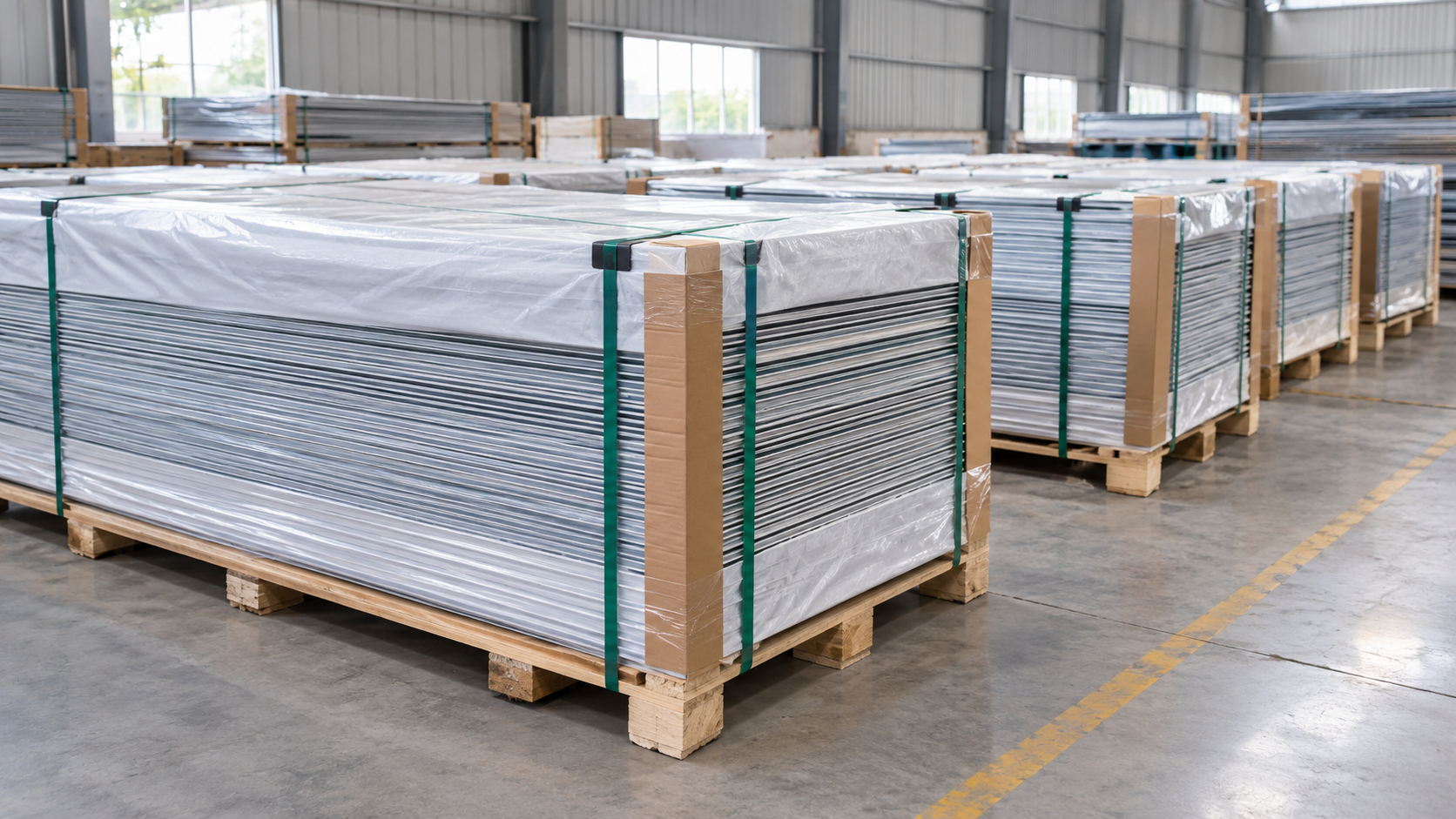
What to Look for in Good ACP Packing
| Packing Element | Why It Matters | What to Check on Arrival |
|---|---|---|
| Protective film on the surface | Stops scratches and dust during handling | Film intact, no tears or bubbles (see our protective film guide) |
| Flat stacking on pallets or a wooden base | Prevents bending and bowing | Stack is level, sheets are not leaning |
| Edge and corner guards | Corners are the weakest point of the panel | No crushed or dented edges |
| Waterproof wrapping | Protects against rain and humidity in transit | Wrapping dry and undamaged |
| Strapping and bundle labels | Keeps the load tight and easy to identify | Labels show size, thickness, colour and batch |
The protective film is also important after delivery. Leaving it on until installation is finished is the easiest way to avoid scratches. If your site is near the sea, read about ACP panel maintenance in coastal areas, because humidity and salt air can affect stored material if the film is left too long.
What to Check When the Truck Arrives
The moment of unloading is your best chance to catch problems. Once the driver leaves and the material is signed for, a damage claim becomes much harder.

Follow this simple checklist:
- Count the bundles against the delivery challan before signing.
- Check the outer packing for tears, water marks or crushed corners.
- Open one or two bundles and look at colour, finish and thickness.
- Match the batch number on the label with your order paperwork.
- Photograph everything if you see damage, with the driver and vehicle number in view.
- Write the damage on the challan before signing, and inform the supplier the same day.
Storing ACP Sheets on Site
Keep sheets flat, off the ground, under cover and away from direct sun and standing water. Do not stack heavy material on top of the bundles. For the long run, our tips on how to maintain and clean ACP sheets are worth sharing with your site team.
Delivery Planning Tips for Different Buyers
Architects and consultants: Fix the colour, finish and thickness early, and mention fire requirements in the order if your project needs FR grade ACP. Changing specifications late is the biggest cause of delay.
Contractors and facade installers: Ask for phased delivery matched to your installation sequence, so material is not lying on site for weeks.
Dealers and traders: Keep a mix of fast-moving colours in stock, and place repeat orders before your stock runs low, not after.
Signage makers and fabricators: For cut-to-size sheets, confirm the cutting tolerance and how cut pieces are packed, since small pieces can scratch each other.
Homeowners and interior designers: Check the colour sample under your own lighting before the full order is released.