You’ve chosen ACP for your building elevation. Then the supplier asks, “3 mm or 4 mm? And what aluminium thickness?” Suddenly two sheets that look identical in the showroom come with very different prices.
Choosing the wrong thickness for an exterior can lead to wavy panels, faded colour or early replacement. This guide explains which ACP sheet thickness is best for exterior use, why the aluminium skin matters even more than the total thickness, and what else to check before you order.
Table of Contents
- What is the best ACP thickness for exterior use?
- Why does aluminium skin thickness matter?
- 3 mm vs 4 mm ACP: what’s the difference?
- When might you need more than 4 mm?
- Which coating and core should exterior ACP have?
- Exterior ACP checklist before you order
- Frequently asked questions
What Is the Best ACP Thickness for Exterior Use?
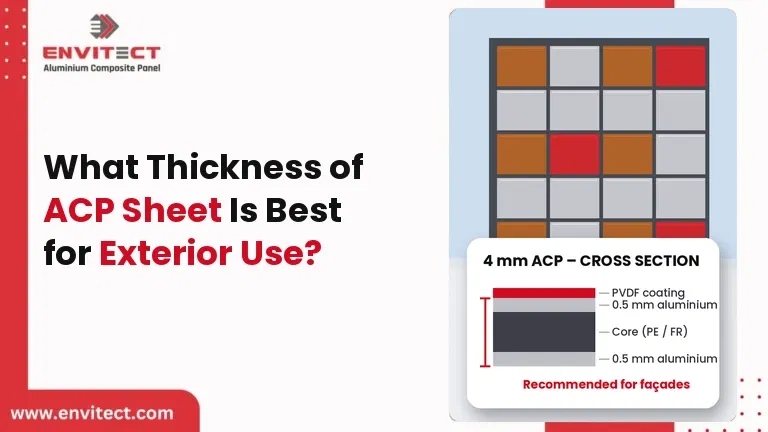
For most exterior cladding and building elevations, 4 mm ACP with 0.5 mm aluminium skins on both sides and a PVDF coating is the commonly used specification. It gives better flatness, rigidity and weather resistance than thinner sheets.
3 mm ACP is generally used for interiors, signage and light-duty work. On an exterior, especially on larger panels or taller buildings, it is more likely to flex, wave or dent.
The right choice still depends on your building height, panel size, wind exposure and fire requirements, so always follow your architect’s or façade consultant’s specification.
Why Does Aluminium Skin Thickness Matter?
The aluminium skins carry most of the panel’s strength, so a 4 mm sheet with thin aluminium can perform worse than you expect. Two 4 mm sheets can have very different skin thicknesses and very different prices.
An ACP sheet has three layers:
- Top aluminium skin, coated with paint (PVDF or polyester)
- Core: polyethylene (PE) or a fire-retardant mineral-filled core
- Bottom aluminium skin, usually with a protective service coat
The total thickness (3 mm, 4 mm, 6 mm) is mostly the core. The aluminium skin thickness (for example 0.21 mm, 0.3 mm or 0.5 mm) decides:
- How flat the panel stays on a large façade
- How well it resists dents and wind pressure
- How well it handles routing, folding and fixing during fabrication
For exteriors, 0.5 mm skins are widely preferred. Always ask for the skin thickness in writing. “4 mm” alone does not tell you enough.
3 mm vs 4 mm ACP: What’s the Difference?
4 mm ACP is stiffer, flatter and better suited to exterior façades, while 3 mm ACP is lighter and more economical for interiors and signage.
| Feature | 3 mm ACP | 4 mm ACP |
|---|---|---|
| Typical aluminium skin | Thinner skins (often 0.21–0.3 mm) | Thicker skins (often 0.5 mm) for exteriors |
| Rigidity and flatness | Lower; may wave on large panels | Higher; better for large façade panels |
| Wind resistance | Limited | Better suited to exterior wind loads |
| Typical coating | Often polyester | Often PVDF for UV and weather resistance |
| Common uses | Interiors, partitions, signage, shop fronts at low height | Building elevations, façades, canopies, exterior cladding |
| Cost | Lower | Higher |
Typical values vary by manufacturer. Always confirm the exact specification on the data sheet.
When Might You Need More Than 4 mm?
Thicker panels or special solutions are considered when panels are very large, wind loads are high, or the building is tall. In these cases, a façade engineer should decide the specification.
Situations that need extra care:
- High-rise buildings, where wind pressure increases with height
- Large panel sizes, with wide spans between subframe supports
- Coastal or very windy locations
- Canopies and projections exposed on both sides
Often the answer is not just a thicker sheet. Closer subframe spacing, stiffeners on the back of the panel and the right fixing system all improve performance. Panel thickness, frame design and fixing work together.
Which Coating and Core Should Exterior ACP Have?
Coating: PVDF for exteriors
PVDF (polyvinylidene fluoride) coating is preferred for exterior ACP because it resists UV rays, weather and colour fading better than polyester coating. Polyester-coated sheets are more economical and are commonly used indoors.
Ask your supplier for:
- The coating type on the data sheet
- The written warranty on colour and coating
- Whether the colour is suitable for strong sun exposure
Core: consider fire-retardant (FR) ACP
Standard PE-core ACP is combustible, so many exterior projects, especially high-rise and public buildings, specify fire-retardant (FR) ACP with a mineral-filled core. Follow your local fire regulations and the project’s fire safety specification.
Certification
In India, aluminium composite panels are covered by IS 17682:2021, and government orders have made BIS certification mandatory, with deadlines extended in the past (Ply Reporter). Ask your supplier for their current BIS licence details.
Exterior ACP Checklist Before You Order
Use this list to compare quotations on the same basis, not just on price per sheet.
- Total panel thickness (4 mm is common for exteriors)
- Aluminium skin thickness, front and back (0.5 mm is widely preferred for exteriors)
- Coating type (PVDF for exteriors) and coating warranty
- Core type (FR core where required)
- BIS licence details under IS 17682
- Sheet size, to reduce joints on the elevation
- Single production batch for the whole project, to avoid colour variation
- Protective film quality, and when to remove it after installation
- Physical sample and shade card approved before production
- Fabrication and fixing plan checked by your façade consultant
Envitect Composite manufactures ACP sheets in Morbi, Gujarat, in solid, metallic, wooden, brush, marble, sparkle and mirror finishes for exterior and interior use. You can explore Envitect ACP sheets and ask for the exterior specification, samples and a quotation for your project.
Frequently Asked Questions
Which ACP sheet thickness is best for exterior use?
For most exterior façades and elevations, 4 mm ACP with 0.5 mm aluminium skins and PVDF coating is the commonly used specification. It offers better flatness, rigidity and weather resistance than 3 mm sheets. Large panels, tall buildings or windy sites may need an engineer’s specification.
Can I use 3 mm ACP for exterior?
3 mm ACP is mainly used for interiors and signage. It can work for small, low-height exterior elements, but on larger façades it is more likely to flex or wave. For building elevations, 4 mm ACP with thicker aluminium skins is the safer choice.
What does 0.5 mm mean in ACP sheets?
It refers to the thickness of each aluminium skin, not the whole panel. A 4 mm sheet with 0.5 mm skins has more aluminium and greater strength than a 4 mm sheet with thinner skins. Always confirm the skin thickness on the specification sheet.
Is PVDF coating necessary for exterior ACP?
PVDF coating is strongly recommended for exteriors because it resists UV rays, rain and fading far better than polyester. Polyester-coated sheets are cheaper but are better suited to interiors or short-term use. Check the coating warranty before ordering.
Is 4 mm ACP fire-resistant?
Thickness does not decide fire performance; the core does. A standard PE-core 4 mm sheet is combustible. For fire safety, choose ACP with a fire-retardant (FR) mineral-filled core, as required by your building’s fire regulations.
Why does ACP cladding look wavy after installation?
Waviness usually comes from thin aluminium skins, large panels with wide subframe spacing, poor fixing, or uneven framing. Using 4 mm ACP with 0.5 mm skins, correct subframe spacing and proper fabrication helps keep panels flat.
How long does exterior ACP last?
Life depends on aluminium quality, coating type, installation and climate. Good-quality PVDF-coated ACP, installed correctly, generally lasts much longer than polyester-coated sheets. Ask your supplier for the written coating warranty.
The Bottom Line
For most exterior uses, 4 mm ACP with 0.5 mm aluminium skins and PVDF coating is the commonly chosen specification. But thickness is only part of the answer: aluminium skin, coating, core, certification and installation decide how your façade looks and performs over the years. Compare full specifications, not just prices, and let your architect or façade consultant confirm the final choice.
Planning a building elevation or façade? Explore Envitect ACP sheets and share your project details for the right exterior specification, samples and a quotation.